Voyager 1 Hits One‑Light‑Day Distance, Signals Take a Full Day to Arrive
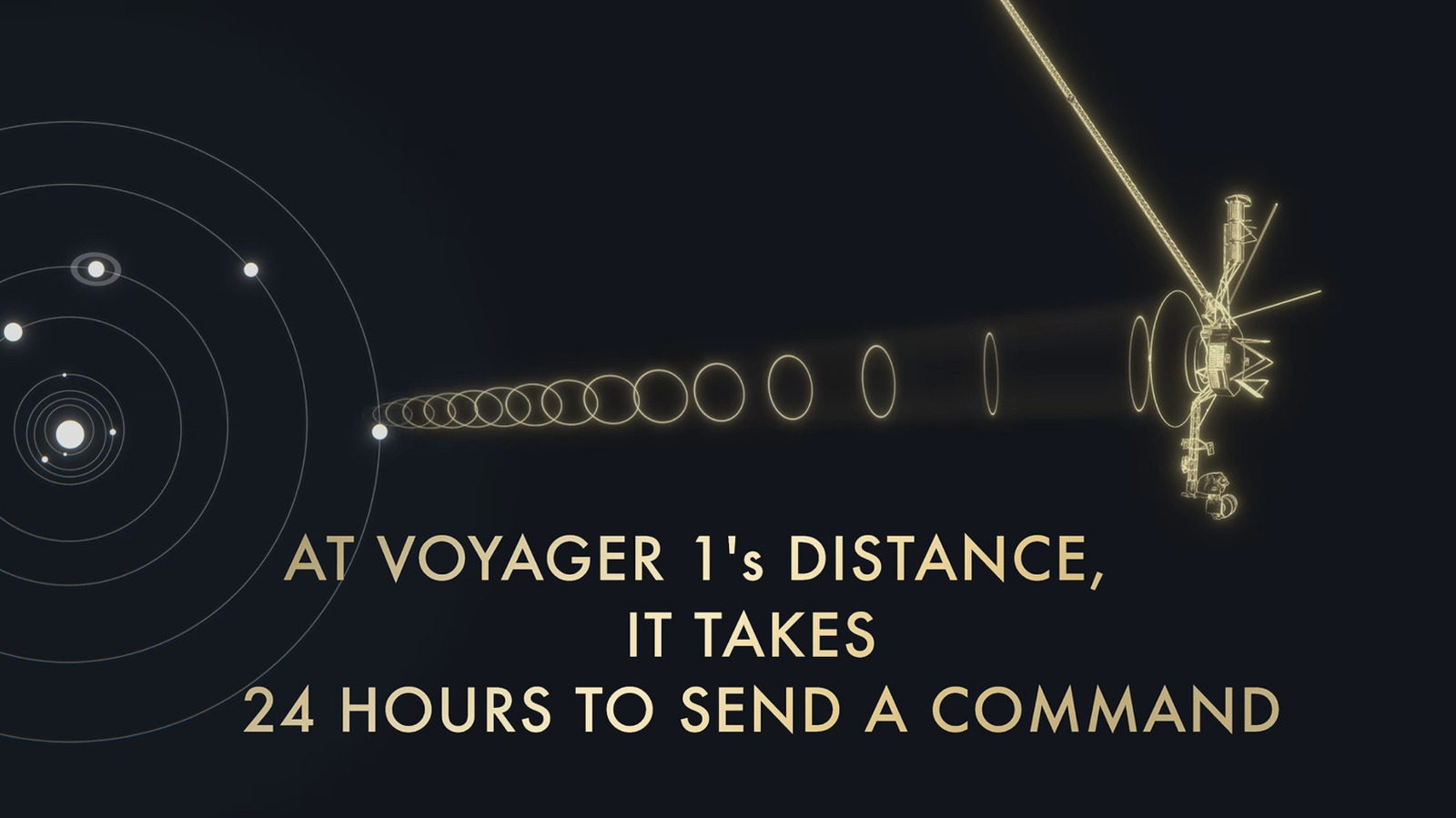
Mission controllers confirmed this week that NASA’s Voyager 1 has now reached a new benchmark, positioned about one light‑day away from Earth, so a radio signal requires roughly 24 hours to reach the spacecraft. Launched over forty years ago, the probe still stretches the boundaries of what humanity has built for space exploration.
In 1977 the twin Voyager probes were sent off to exploit an uncommon planetary alignment, sending back detailed pictures of Jupiter and Saturn before heading on paths that would ultimately leave the solar system. The quicker of the two, Voyager 1, finished its outer‑planet flybys and entered interstellar space in 2012, marking the first time a human‑made object left the Sun’s domain.
One light‑day is the span that light covers in a full day, approximately 26 billion km (around 16 billion mi). At that separation Voyager 1 lies far past Pluto’s orbit and even beyond the heliopause, the zone where the solar wind gives way to interstellar space. Its present location, exceeding 150 AU from the Sun, continues to grow year after year.
Maintaining contact with a probe at this range is a technological challenge. NASA’s Deep Space Network, comprising worldwide 70‑m and 34‑m dishes, has to capture a signal that is billions of times fainter than ordinary broadcasts. Because a message needs a full day to reach Voyager 1, any command sent cannot be verified until 24 hours later, and data—like cosmic‑ray readings—returns after an equivalent lag.
Three radio‑isotope thermoelectric generators (RTGs) supply Voyager 1’s electricity by turning the heat from decaying plutonium‑238 into power. After many years the generated wattage has dwindled to only a few hundred watts, sufficient merely for the transmitter and a small suite of instruments. Engineers project that the RTGs will cease to deliver adequate power in the late 2020s, prompting the official end of the mission.
Even with the shrinking power supply, the spacecraft keeps returning important scientific data. Its plasma wave instrument measures the density of charged particles in interstellar space, and its magnetometer charts the galaxy‑spanning magnetic field. Collected far beyond any other human‑built vehicle, these observations improve models of how the heliosphere interacts with the surrounding environment.
Going forward, NASA intends to operate the probe for as long as its power lasts, periodically uploading software patches from Earth to focus on the most essential instruments. Once the signal eventually drops out, Voyager 1 will become a quiet envoy wandering the galaxy, still bearing its golden record as a cultural time capsule of Earth.
This milestone highlights how a project designed in the 1970s continues to influence scientific knowledge today. As other deep‑space initiatives like the Interstellar Probe advance from concept to development, Voyager’s durability serves both as a yardstick and as motivation for upcoming generations aiming to project humanity’s voice deeper into the universe.


Comments (0)
Be the first to comment.
Join the discussion