Satellite Imagery Shows Shiveluch’s Lava Dome Growing, Molten Flow Resembles Toothpaste
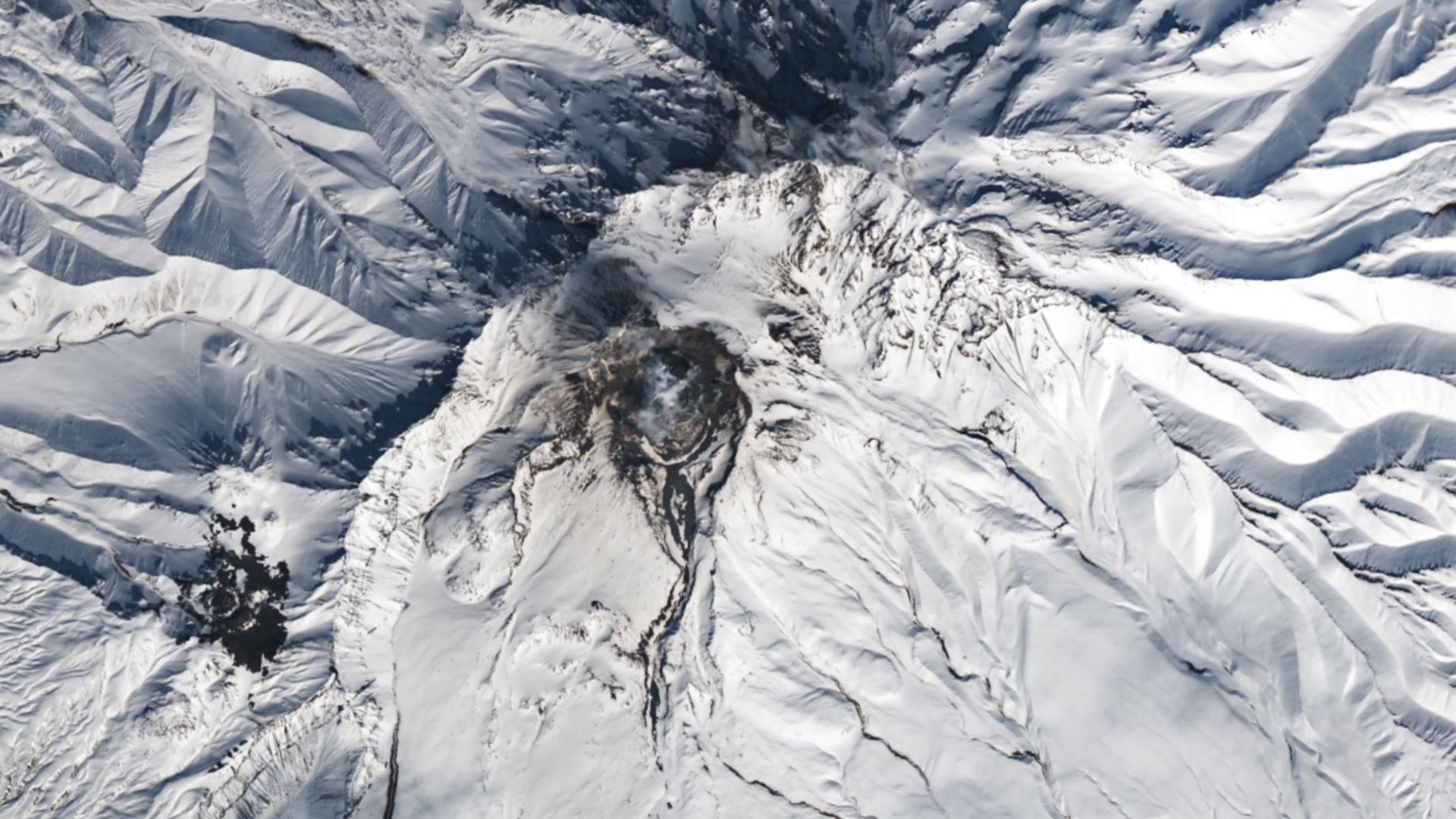
A satellite photograph taken on 23 April 2026 reveals a quickly enlarging lava dome atop Shiveluch, the highly active volcano on Russia’s Kamchatka Peninsula, with hot lava flowing over the adjacent snow in a fashion compared to toothpaste.
Rising more than 3,300 metres above sea level, Shiveluch has ranked among the region’s most persistently eruptive volcanoes for decades. Its frequent explosions and ash plumes have earned it a reputation for sudden, hazardous activity, prompting continuous monitoring by Russian and international observatories.
The picture was obtained by the Landsat 9 satellite, whose multispectral sensors captured the stark contrast between bright snowfields and the dark, viscous lava descending the crater walls. The image highlights a clear band of melt that is beginning to wear away the snow cover, indicating that the dome’s expansion is outpacing the rate at which the frozen mantle can refreeze.
Scientists caution that such dome growth can raise the chance of a sector collapse—a type of landslide capable of triggering explosive pyroclastic flows or producing lahars when meltwater mixes with volcanic debris. Although the immediate area around Shiveluch is sparsely populated, nearby communities such as Klyuchi and the town of Petropavlovsk‑Kamchatsky could experience ash fall or secondary flooding if a collapse occurs.
Lava domes develop when viscous magma extrudes slowly, accumulating near the vent instead of flowing away. Their enlargement is often marked by periods of rapid inflation followed by sudden collapse. Modern monitoring combines satellite imaging, ground‑based seismic networks and thermal cameras to spot subtle shifts in dome shape, temperature and gas emissions.
The Russian Federal Service for Supervision of Natural Monopolies (Rosprirodnadzor) has issued an advisory urging local authorities to keep evacuation routes ready and to maintain air‑traffic alerts for the region’s busy flight paths. Researchers expect that later passes of Landsat 9 and other Earth‑observation platforms will continue to track the dome’s evolution, delivering essential data for hazard assessments in the weeks ahead.


Comments (0)
Be the first to comment.
Join the discussion