Mercedes‑Benz Launches Holographic HUD, Transforming Luxury Car Cabins
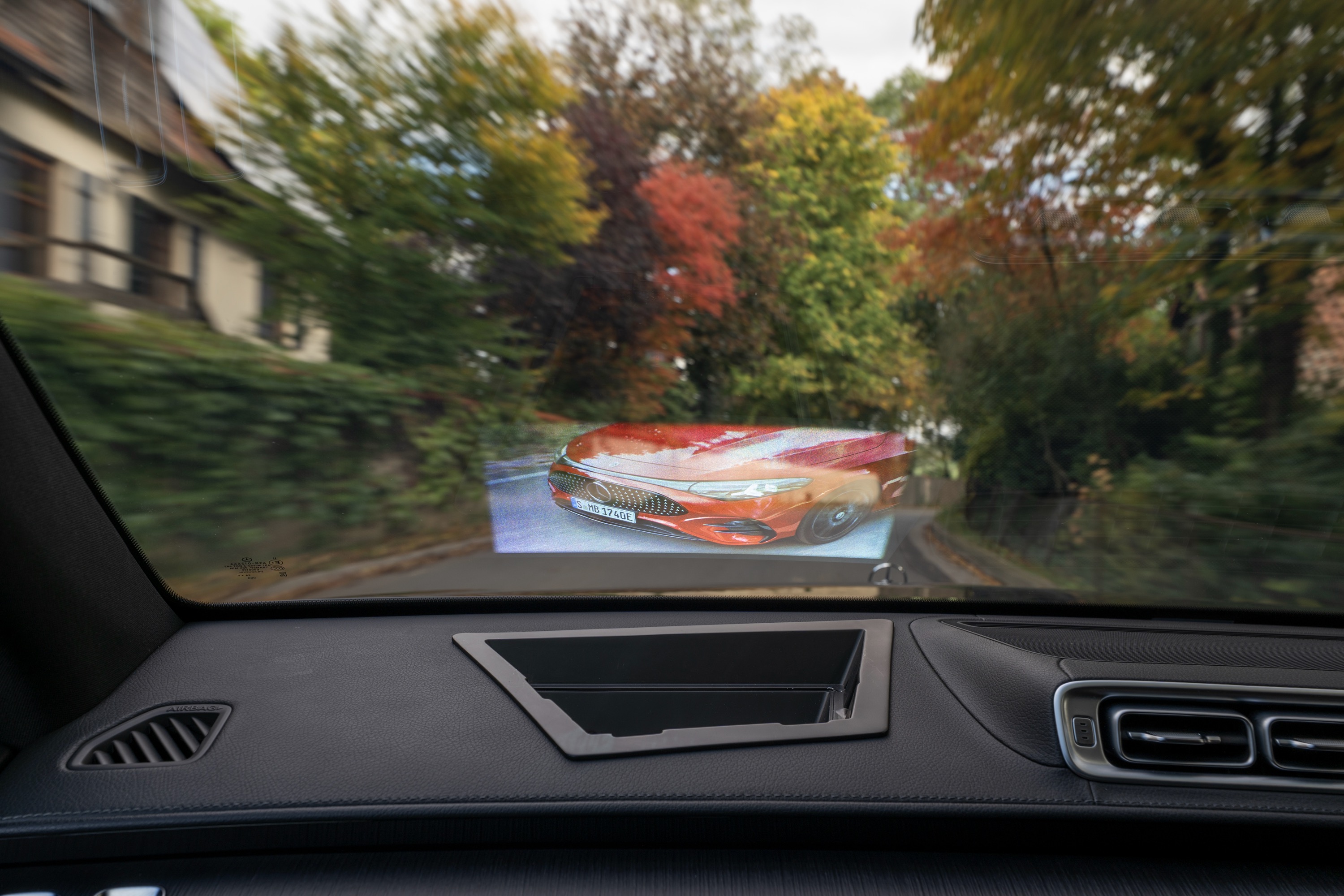
Mercedes‑Benz has introduced a holographic heads‑up display (HUD) that casts essential driving information onto a glass panel situated above the windshield, signifying a move away from traditional flat screens toward three‑dimensional visual cues in luxury cars.
This step aligns with a wider industry shift in which digital screens are emerging as defining features of premium vehicle cabins. In recent years, automakers have grown screen real‑estate from a solitary infotainment unit to numerous touchpoints spanning the dashboard, center console and even the steering wheel, converting the cabin into a dynamic digital cockpit.
In contrast to prior HUDs that merely superimposed simple speed and navigation icons, Mercedes’s new system employs laser‑based projection to generate floating graphics that seem to drift within the driver’s sightline. The unit can modify depth and scale instantly, presenting data like speed limits, navigation arrows and driver‑assist warnings with spatial depth, thereby diminishing the urge to glance away from the road.
Conventional HUDs have suffered from brightness and resolution limits, frequently failing to stay readable in direct sunlight. The holographic method utilizes a high‑resolution micro‑display together with diffractive optics to enhance clarity while keeping power draw low, an important factor for electric‑driven models where efficiency is crucial.
Analysts view the technology as a differentiator in the intensely competitive luxury market, where manufacturers battle to deliver the most futuristic cabin experience. By embedding a holographic interface, Mercedes‑Benz casts itself as a trailblazer, possibly urging competitors to speed up their own augmented‑reality display research.
Cost and manufacturing scalability are still uncertain. Sophisticated optics and laser modules increase supply‑chain complexity, and initial buyers could encounter a premium price. Still, the firm intends to deploy the system across its flagship S‑Class and EQ models in the upcoming model year, indicating confidence in its commercial viability.
Should the holographic HUD catch on, it may reshape driver‑vehicle interaction norms, steering the industry toward more immersive, glance‑free interfaces. The subsequent stage could see integration with external sensors to superimpose real‑time road conditions, further eroding the boundary between physical and digital driving realms.



Comments (0)
Be the first to comment.
Join the discussion