ESA’s Hera Spacecraft to Study DART‑Created Crater on Didymos System This November
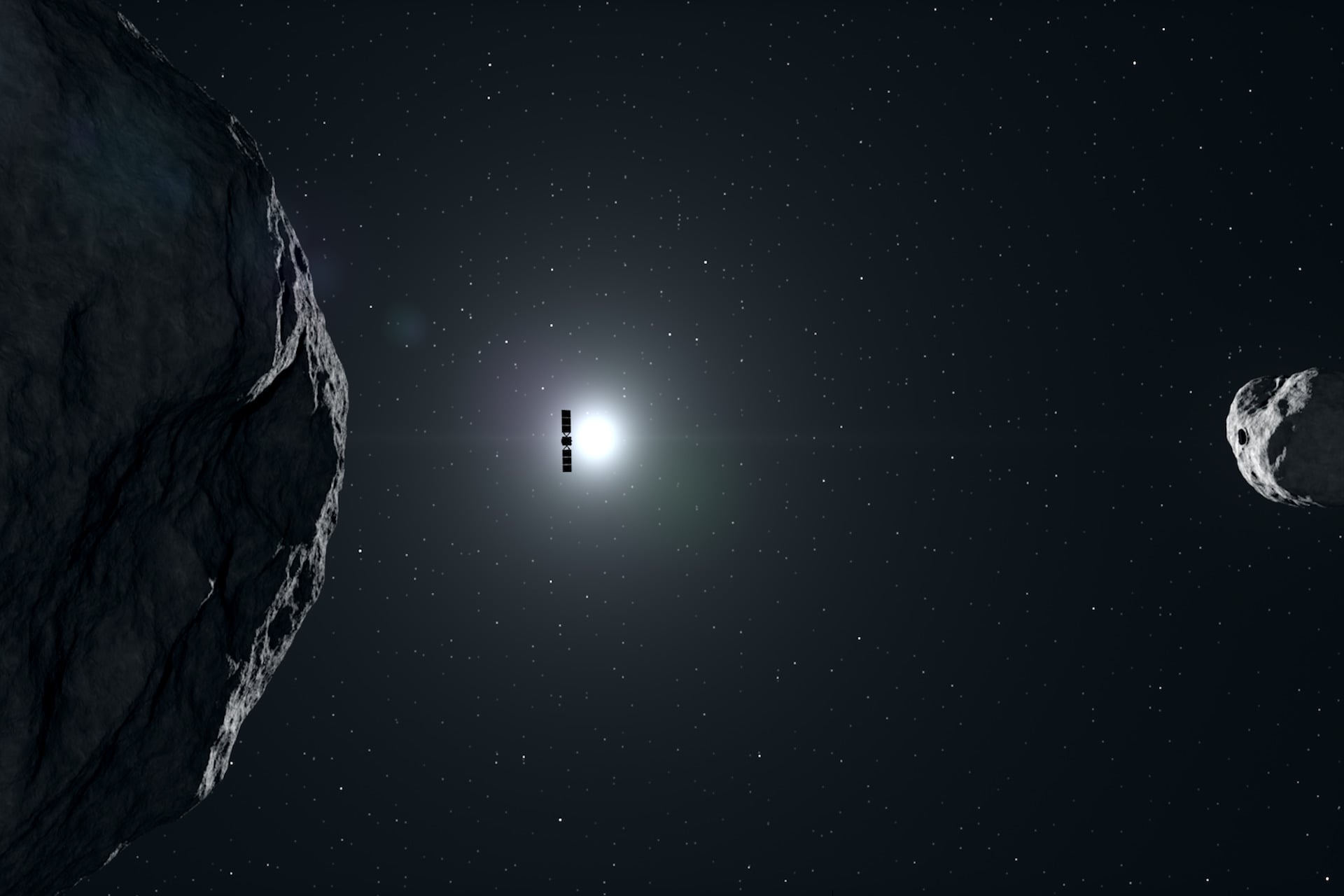
The European Space Agency’s Hera probe is slated to encounter the binary asteroid Didymos in November, where it will perform the inaugural close‑up examination of the crater produced by NASA’s Double Asteroid Redirection Test (DART) mission. This fly‑by will let researchers evaluate the damage to Dimorphos—the tiny companion moon of the near‑Earth asteroid Didymos—resulting from DART’s kinetic‑impact maneuver in September 2022.
As a component of the Asteroid Impact and Deflection Assessment (AIDA) partnership linking ESA and NASA, Hera is equipped with high‑resolution imagers, a lidar system and a low‑frequency radar. Using these instruments, the spacecraft will chart the terrain of Didymos and Dimorphos, determine the dimensions and shape of the impact crater, and assess any orbital shift of the moon resulting from the collision. The measurements should sharpen calculations of the momentum transferred in the impact, a key element for upcoming planetary‑defence concepts.
Launched in 2021, the DART mission represented the inaugural deliberate effort to change an asteroid’s path by impacting it with a spacecraft. Although telescopic observations on Earth verified that Dimorphos’s orbital period was reduced by a few minutes, the exact dynamics of the momentum exchange are still ambiguous. Hera’s proximity measurements will address this uncertainty, providing a direct validation of the models that estimate how well kinetic impactors can neutralize potentially dangerous bodies.
In addition to its core scientific objectives, Hera’s results will contribute to worldwide initiatives aimed at establishing dependable deflection methods. ESA intends to apply the mission’s insights when shaping upcoming projects that might shield Earth from bigger, more threatening asteroids. By analyzing the composition of the asteroid duo and the debris field generated after impact, Hera will assess whether kinetic strikes can be amplified or paired with alternatives like gravity tractors or laser ablation.
The October 2024 launch of Hera and its ensuing voyage toward the Didymos system have been watched closely by the planetary‑defence sector. The November fly‑by represents a landmark for both the AIDA collaboration and the fledgling discipline of asteroid mitigation. As Hera draws near the binary pair, mission controllers will initiate a sequence of close‑range observations lasting several months, delivering an extensive data set that may influence the next wave of planetary‑protection strategies.



Comments (0)
Be the first to comment.
Join the discussion