Astronomers Directly Observe a Giant Star Swallowing Its Smaller Companion
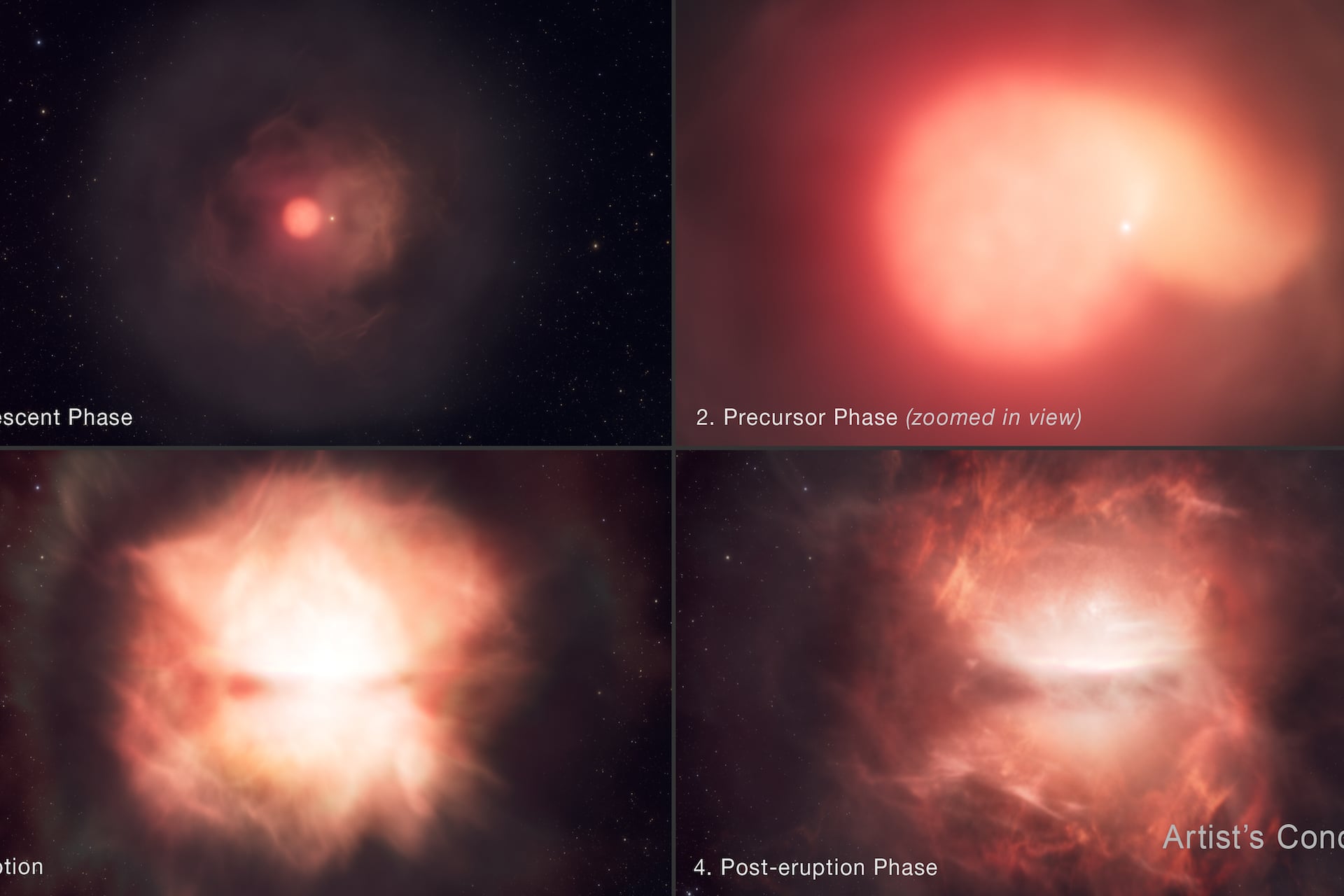
Scientists have, for the first time, captured a colossal, dying star as it swallows a smaller adjacent star, providing an unmatched glimpse into the mechanics of stellar mergers that have long been hypothesized yet never directly seen.
The event was detected through a blend of space‑based instruments and terrestrial observatories tracking a luminous red‑giant nearing the end of its evolution. As the giant swelled, its outer envelope dragged the smaller companion into a spiraling plunge, culminating in a merger inside the giant’s atmosphere. Observations across several wavelengths let researchers follow the encounter as it unfolded.
These “common‑envelope” episodes represent a vital, though still enigmatic, stage in the evolution of binary stars. Once a star depletes its nuclear fuel and expands into a red giant, it may breach its Roche lobe, engulfing a close companion. The resulting drag saps the companion’s orbital energy, tightening the orbit and possibly prompting a merger or the expulsion of the giant’s outer shell. Before this direct capture, scientists depended on indirect clues like atypical stellar leftovers or swift luminosity fluctuations to deduce such events.
The observations show a swift increase in infrared and optical brightness, together with unique spectral markers pointing to hot gas and dust being hurled from the system. Modeling the light curves leads the team to infer that the lesser star possessed about one‑tenth the mass of the giant, and that the merger unfolded over weeks to months—a rate that tests several current theoretical models. The results also imply that the aftermath could be a dense, potentially magnetically active core that might later develop into an exotic object—perhaps a close binary white dwarf or a neutron star—contingent on the total mass.
Going forward, researchers intend to comb through archival records for comparable transient phenomena and to sharpen simulation software using the fresh empirical limits. Directly witnessing a common‑envelope phase should refine forecasts of close binary formation rates, which affect projections for events such as Type Ia supernovae and gravitational‑wave sources. As an increasing number of observatories gain the capacity for swift, multi‑wavelength surveillance, the community expects more mergers to be observed in real time, progressively converting a formerly theoretical phase of stellar evolution into a well‑mapped segment of cosmic history.



Comments (0)
Be the first to comment.
Join the discussion