AI Enables 12‑Ton John Deere Loader to Perform Two‑Wheel Balancing Acts
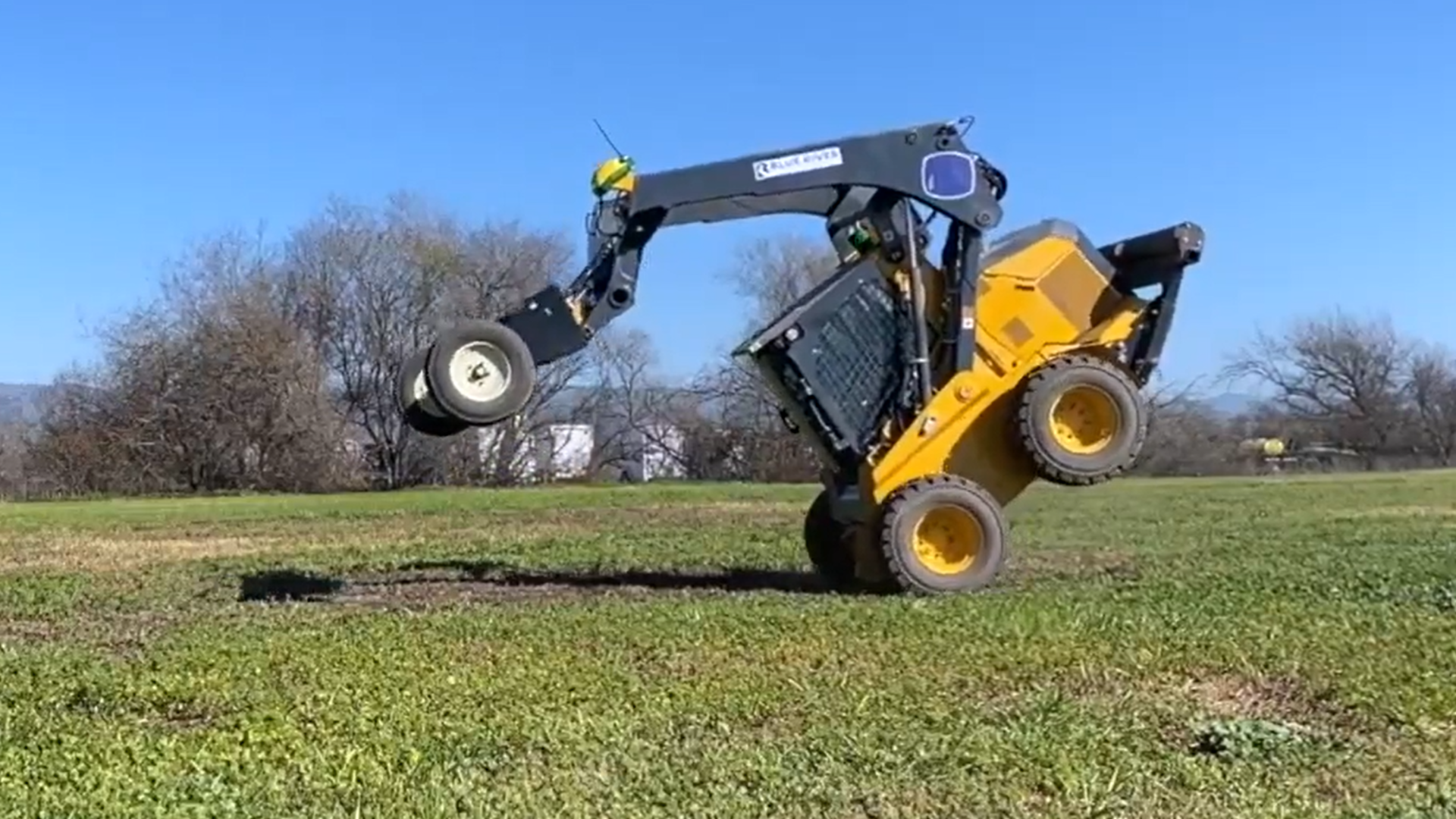
Researchers have shown that a 12,000‑pound John Deere skid‑steer loader can carry out intricate, balance‑heavy maneuvers without a human operator, including spinning and staying upright on uneven terrain while perched on just two wheels. This milestone represents a significant advance in autonomous heavy‑equipment capabilities, illustrating how machine‑learning methods can turn high‑risk actions into repeatable, controlled motions.
The work began in a simulated setting, where the loader’s control logic was honed through extensive virtual testing. By feeding the AI countless variations—different slope angles, wheel‑grip conditions, and moving obstacles—the system learned to predict and correct balance disturbances in real time. After the simulated runs satisfied safety criteria, the learned policies were uploaded to an actual loader for live trials.
In the field demonstrations, the machine performed a suite of acrobatic tasks that would normally demand a seasoned driver. It raised one side of its frame, steadied itself on the remaining two wheels, and executed full rotations while staying stable on a non‑uniform surface. Witnesses reported that the loader accomplished these actions without any manual control, relying solely on the pre‑trained neural network to adjust wheel torque and steering angles.
This breakthrough mirrors a wider movement toward embedding artificial intelligence in construction and earth‑moving machinery. Automation is expected to ease labor shortages, boost safety by keeping workers out of dangerous zones, and enhance precision for tasks that require fine motor control. Nonetheless, experts warn that broad adoption will need thorough validation, especially in unpredictable real‑world environments beyond controlled test sites.
Analysts envision uses ranging from demolition—where exact, repeatable motions can limit collateral damage—to mining operations that could profit from autonomous loaders navigating steep, unstable pits. The two‑wheel balancing ability might also let equipment slip through narrow passages or surmount obstacles that would stall conventional machines.
Although the current trials are still experimental, the research team intends to broaden the system’s scope by adding more sensors and fine‑tuning the learning framework to tackle a wider variety of tasks. As the technology matures, it could usher in fully autonomous construction fleets, fundamentally changing how heavy machinery is operated on job sites worldwide.



Comments (0)
Be the first to comment.
Join the discussion